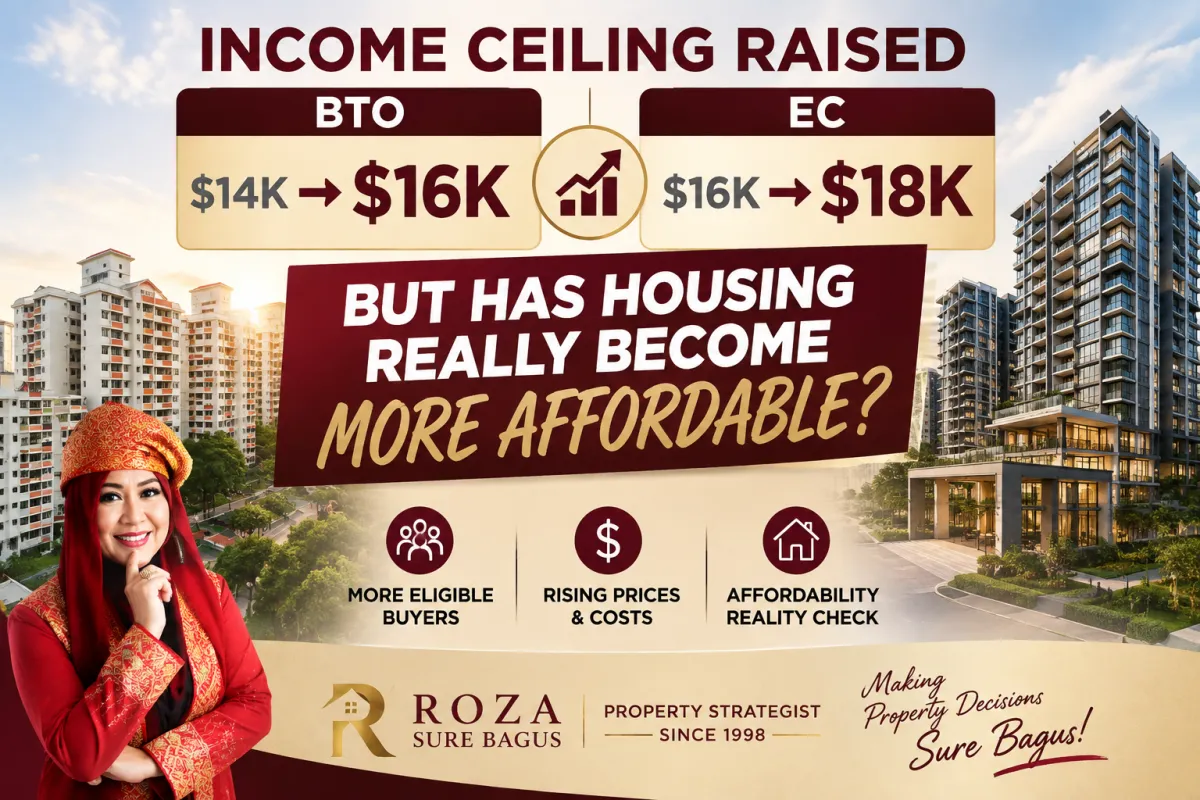
Income Ceiling Raised to $16K for BTO & $18K for EC — But Has Housing Really Become More Affordable?
𝐓𝐡𝐞 𝐢𝐧𝐜𝐨𝐦𝐞 𝐜𝐞𝐢𝐥𝐢𝐧𝐠 𝐡𝐚𝐬 𝐠𝐨𝐧𝐞 𝐮𝐩. 𝐁𝐮𝐭 𝐡𝐚𝐬 𝐡𝐨𝐮𝐬𝐢𝐧𝐠 𝐚𝐜𝐭𝐮𝐚𝐥𝐥𝐲 𝐛𝐞𝐜𝐨𝐦𝐞 𝐌𝐎𝐑𝐄 𝐚𝐟𝐟𝐨𝐫𝐝𝐚𝐛𝐥𝐞
During the National Day Rally, PM Lawrence Wong announced that the household income ceiling for new BTO flats will be raised from $𝟏𝟒,𝟎𝟎𝟎 𝐭𝐨 $𝟏𝟔,𝟎𝟎𝟎, while the ceiling for 𝐄𝐱𝐞𝐜𝐮𝐭𝐢𝐯𝐞 𝐂𝐨𝐧𝐝𝐨𝐦𝐢𝐧𝐢𝐮𝐦𝐬 (𝐄𝐂𝐬) 𝐰𝐢𝐥𝐥 𝐫𝐢𝐬𝐞 𝐟𝐫𝐨𝐦 $𝟏𝟔,𝟎𝟎𝟎 𝐭𝐨 $𝟏𝟖,𝟎𝟎𝟎.
On the surface, this certainly sounds like good news.
More Singaporeans can qualify for BTOs.
More middle-income families can qualify for ECs.
But as someone who has been in the property market since 1998, I look at this announcement from a slightly different perspective.

Because being eligible to buy and being able to comfortably afford to buy are two very different things.
Think about a household earning $17,000 a month.
Previously, they exceeded the EC income ceiling. With the new $18,000 ceiling, EC suddenly becomes an option.
Great news?
Perhaps.
But here's the next question:
𝘼𝙩 𝙩𝙤𝙙𝙖𝙮'𝙨 𝙀𝘾 𝙥𝙧𝙞𝙘𝙚𝙨, 𝙘𝙖𝙣 𝙩𝙝𝙞𝙨 𝙝𝙤𝙪𝙨𝙚𝙝𝙤𝙡𝙙 𝙘𝙤𝙢𝙛𝙤𝙧𝙩𝙖𝙗𝙡𝙮 𝙖𝙛𝙛𝙤𝙧𝙙 𝙤𝙣𝙚?
That's where the conversation becomes more complicated.
Household incomes have increased over the years — but so have property prices.
New BTO flats in attractive locations can command substantial prices. HDB resale prices have also risen significantly. EC prices have moved upwards, and making the leap into a private condominium has become increasingly challenging for many middle-income households.
And this is where we have what I call the “𝙨𝙖𝙣𝙙𝙬𝙞𝙘𝙝 𝙘𝙡𝙖𝙨𝙨 𝙙𝙞𝙡𝙚𝙢𝙢𝙖..”
You may earn too much to qualify for certain housing assistance, yet you may still find today's private property prices uncomfortable or even beyond your prudent affordability range.
So while raising the income ceiling certainly 𝐰𝐢𝐝𝐞𝐧𝐬 𝐞𝐥𝐢𝐠𝐢𝐛𝐢𝐥𝐢𝐭𝐲, it doesn't automatically solve the bigger issue of 𝐡𝐨𝐮𝐬𝐢𝐧𝐠 𝐚𝐟𝐟𝐨𝐫𝐝𝐚𝐛𝐢𝐥𝐢𝐭𝐲.
𝐓𝐡𝐞 𝐆𝐨𝐯𝐞𝐫𝐧𝐦𝐞𝐧𝐭 𝐫𝐚𝐢𝐬𝐞𝐝 𝐭𝐡𝐞 𝐢𝐧𝐜𝐨𝐦𝐞 𝐜𝐞𝐢𝐥𝐢𝐧𝐠. 𝐔𝐧𝐟𝐨𝐫𝐭𝐮𝐧𝐚𝐭𝐞𝐥𝐲, 𝐩𝐫𝐨𝐩𝐞𝐫𝐭𝐲 𝐩𝐫𝐢𝐜𝐞𝐬 𝐝𝐢𝐝𝐧'𝐭 𝐬𝐭𝐚𝐲 𝐰𝐡𝐞𝐫𝐞 𝐭𝐡𝐞𝐲 𝐰𝐞𝐫𝐞.
And perhaps that's the more important conversation we should be having.
𝙄𝙣𝙨𝙩𝙚𝙖𝙙 𝙤𝙛 𝙖𝙨𝙠𝙞𝙣𝙜:
“𝐖𝐡𝐚𝐭 𝐩𝐫𝐨𝐩𝐞𝐫𝐭𝐲 𝐚𝐦 𝐈 𝐞𝐥𝐢𝐠𝐢𝐛𝐥𝐞 𝐭𝐨 𝐛𝐮𝐲?”
𝙋𝙚𝙧𝙝𝙖𝙥𝙨 𝙬𝙚 𝙨𝙝𝙤𝙪𝙡𝙙 𝙗𝙚 𝙖𝙨𝙠𝙞𝙣𝙜:
“𝐖𝐡𝐚𝐭 𝐩𝐫𝐨𝐩𝐞𝐫𝐭𝐲 𝐜𝐚𝐧 𝐈 𝐜𝐨𝐦𝐟𝐨𝐫𝐭𝐚𝐛𝐥𝐲 𝐚𝐟𝐟𝐨𝐫𝐝 — 𝐰𝐢𝐭𝐡𝐨𝐮𝐭 𝐬𝐭𝐫𝐞𝐭𝐜𝐡𝐢𝐧𝐠 𝐦𝐲 𝐟𝐢𝐧𝐚𝐧𝐜𝐞𝐬 𝐟𝐨𝐫 𝐭𝐡𝐞 𝐧𝐞𝐱𝐭 𝟐𝟎 𝐨𝐫 𝟐𝟓 𝐲𝐞𝐚𝐫𝐬?”
Especially for existing HDB owners thinking of upgrading, the calculation goes much deeper than household income.
What is your outstanding loan
How much CPF needs to be refunded when you sell
How much actual cash and CPF will you have left
What loan can you realistically obtain at your current age
And most importantly — 𝐰𝐡𝐚𝐭 𝐰𝐢𝐥𝐥 𝐲𝐨𝐮𝐫 𝐦𝐨𝐧𝐭𝐡𝐥𝐲 𝐜𝐨𝐦𝐦𝐢𝐭𝐦𝐞𝐧𝐭 𝐥𝐨𝐨𝐤 𝐥𝐢𝐤𝐞 𝐚𝐟𝐭𝐞𝐫 𝐮𝐩𝐠𝐫𝐚𝐝𝐢𝐧𝐠
Because qualifying for an EC doesn't necessarily mean that buying an EC is the right financial decision for you.
Sometimes upgrading makes sense.
Sometimes staying put and building your financial position makes more sense.
And sometimes there is another property strategy altogether.
After all, 𝐞𝐥𝐢𝐠𝐢𝐛𝐢𝐥𝐢𝐭𝐲 𝐢𝐬 𝐝𝐞𝐭𝐞𝐫𝐦𝐢𝐧𝐞𝐝 𝐛𝐲 𝐩𝐨𝐥𝐢𝐜𝐲. 𝐀𝐟𝐟𝐨𝐫𝐝𝐚𝐛𝐢𝐥𝐢𝐭𝐲 𝐢𝐬 𝐝𝐞𝐭𝐞𝐫𝐦𝐢𝐧𝐞𝐝 𝐛𝐲 𝐲𝐨𝐮𝐫 𝐨𝐰𝐧 𝐧𝐮𝐦𝐛𝐞𝐫𝐬.
And the two should never be confused.
Property Strategist since 1998


